The 16th and early 17th centuries are often remembered as a time of great cultural flowering in England, the age of Shakespeare and Elizabeth I. Yet for the inhabitants of Retford, this period was marked not by artistic achievement but by a devastating series of disasters that repeatedly brought the town to its knees. Three major fires and several outbreaks of plague struck Retford during this tumultuous century and a half, destroying property, killing hundreds of residents, and fundamentally shaping the development of the town. The story of these catastrophes offers a sobering reminder of the precariousness of life in early modern England and the resilience of the communities that endured these repeated blows.
The Great Fire of 1528
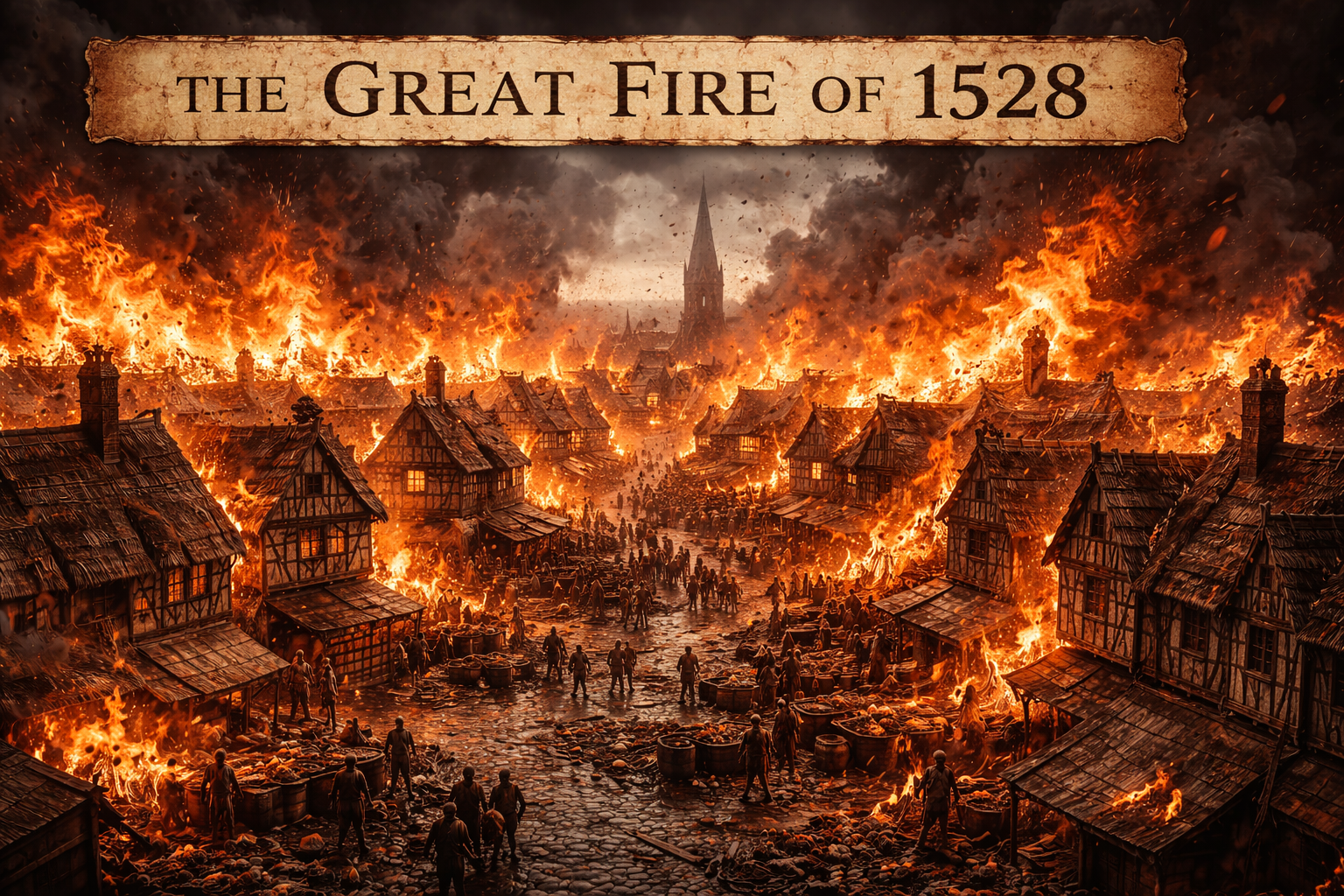
The first and most devastating of Retford's fires struck in 1528, during the reign of Henry VIII. This conflagration destroyed over three-quarters of the borough, leaving the vast majority of Retford's residents homeless and destitute. The scale of the destruction is difficult to comprehend from our modern perspective. In an instant, the accumulated buildings and possessions of generations were reduced to ash. The market place, which had been the centre of the town's commercial life for over four centuries, was left in ruins. The houses lining the principal streets radiating from the square were destroyed. Centuries of slow, incremental development were wiped out in a single catastrophic event.
The devastation was so complete that rebuilding could not begin immediately. It would be twelve years before reconstruction got properly underway in 1540. This long delay speaks to the magnitude of the disaster. The residents of Retford did not simply lack the resources to rebuild their homes; many had lost everything they owned, including the tools of their trades and the goods they would have sold at market. The borough's economic life had been shattered along with its physical fabric.
The causes of the fire are not recorded, but in the context of 16th-century urban life, fires were an ever-present danger. Houses were built primarily of timber with thatched roofs, creating structures that were essentially kindling waiting for a spark. Open fires were used for heating and cooking, candles and rush lights provided illumination, and various trades involving fire—blacksmiths, bakers, brewers—operated throughout the town. It would have taken only a moment of carelessness, a gust of wind at the wrong moment, or a simple accident for a small fire to begin. Once started, fires could spread with terrifying speed through the tightly packed streets of a medieval town, jumping from building to building faster than residents could organise effective resistance.
Medieval and early modern towns had few effective means of fighting fires. There were no fire engines, no organised fire brigades, and no reliable water supply that could be quickly accessed. Residents would have formed bucket chains, passing containers of water from wells or the River Idle, but against a major fire, such efforts were largely futile. The best hope was often to create firebreaks by pulling down buildings in the path of the flames, sacrificing some properties to save others. Given that over three-quarters of Retford burned, it seems clear that such efforts, if they were attempted, met with little success.
Fire Returns: The 1585 Disaster
Just as Retford was recovering and rebuilding from the 1528 catastrophe, disaster struck again. In 1585, another major fire swept through the town. Whilst we lack detailed records of this fire's extent, we know it was severe enough that neighbouring Worksop raised money "for the poor men of the late burned town of Retford." This gesture of inter-community solidarity highlights both the severity of the disaster and the networks of mutual support that existed between nearby towns in this period.
The 1585 fire is particularly poignant because it struck a community that was still recovering from the earlier disaster. The buildings destroyed in this fire would have included many that had only recently been rebuilt following the 1528 conflagration. One can only imagine the despair of residents who found themselves homeless once again, having spent decades rebuilding their lives and their town only to see their work reduced to ashes in a matter of hours.
The fact that Worksop residents felt moved to raise funds for Retford's "poor men" suggests that this fire particularly affected those with the fewest resources to recover. In any disaster, it is the poor who suffer most acutely. Wealthy residents might have property elsewhere, reserves of money, or connections that could help them recover. The poor had nothing but what they could carry, and when fire destroyed their homes, they were left truly destitute.
The frequency of these fires must have had a profound psychological impact on Retford's residents. The knowledge that at any moment, everything they had worked for could be destroyed by fire must have been a constant source of anxiety. Yet people continued to live in Retford, continued to rebuild, and continued to conduct their lives and businesses. This resilience in the face of repeated catastrophe is one of the most striking features of early modern urban life.
The Third Conflagration: 1631
The pattern of destruction continued into the 17th century. In 1631, yet another fire struck Retford, causing £1,300 worth of damage. This figure, substantial for the time, allows us to quantify the disaster in economic terms. To put this in perspective, £1,300 in 1631 represented an enormous sum, equivalent to many years' income for most residents. The damage included not just the buildings themselves but also the goods, tools, and possessions they contained.
By this third fire, the people of Retford must have begun to see a terrible pattern emerging. The town seemed cursed, doomed to be repeatedly consumed by flames. One wonders whether some residents, after losing their homes for the second or third time, simply gave up and moved elsewhere. Yet the town survived, and people continued to rebuild, demonstrating a remarkable determination to maintain their community despite the repeated disasters.
The economic impact of these repeated fires on Retford's development cannot be overstated. Each fire set back the town's progress by decades. Capital that might have been invested in expanding trade, improving infrastructure, or developing new industries was instead directed towards the basic necessity of rebuilding what had been destroyed. Merchants who might have grown their businesses found themselves starting over from nothing. Craftsmen lost their workshops and tools. The cumulative effect of three major fires over roughly a century must have significantly retarded Retford's economic development relative to towns that were spared such catastrophes.
Plague Compounds the Misery
As if the fires were not enough, Retford also suffered several devastating outbreaks of plague during this period. The plague was a constant threat in early modern England, with major epidemics sweeping the country periodically and killing thousands. Retford did not escape this scourge.
The outbreak of 1558 was particularly severe, with around 300 deaths recorded in East Retford. To appreciate the magnitude of this disaster, we must consider it in proportion to the town's population. In the 16th century, Retford was a small town, with a population probably numbering only a few thousand at most. Three hundred deaths therefore represented a substantial proportion of the community—perhaps as much as 20 or 30 percent of the total population. Virtually every family in Retford would have lost members to the disease.
West Retford suffered even more dramatically. The settlement lost over half its population to the plague. This catastrophic mortality rate must have come close to destroying West Retford as a viable community. With more than half the residents dead, there would have been insufficient people to maintain the agricultural and economic activities that sustained the settlement. Houses stood empty, fields went untended, and the social fabric of the community was torn apart.
The plague's impact went beyond the immediate deaths it caused. The disease struck unpredictably, and there was no effective treatment. Victims typically died within days of showing symptoms, their bodies covered in the characteristic buboes that gave the bubonic plague its name. Families were torn apart, with children losing parents, parents losing children, and spouses losing each other. The psychological trauma of watching loved ones die in agony, knowing that you might be next, must have been overwhelming.
Moreover, plague epidemics disrupted all normal economic and social activity. Markets closed, trade ceased, and people avoided contact with their neighbours out of fear of infection. In a town like Retford, which depended on its market and fairs for its prosperity, a plague outbreak could be economically devastating even beyond the loss of life it caused. Merchants from other towns would avoid Retford during an outbreak, cutting off trade connections. Local commerce ground to a halt as people barricaded themselves in their homes. The effects of a plague epidemic could therefore last far longer than the outbreak itself, as the town struggled to rebuild its economic networks and recover lost trade.
Religious and Psychological Impact
The repeated catastrophes that struck Retford during the 16th and early 17th centuries must have had a profound effect on the religious faith and worldview of its inhabitants. In an age when most people understood disasters as expressions of divine will, the repeated fires and plague outbreaks would have raised troubling questions. Why was God punishing Retford? What sins had the townspeople committed to deserve such repeated chastisement?
This period coincided with the English Reformation, when traditional Catholic practices were abolished and a new Protestant church was established. The first fire in 1528 occurred just as Henry VIII was beginning to assert royal control over the church. The subsequent fires and plague outbreaks spanned the reigns of Edward VI, Mary I, and Elizabeth I, each of whom imposed different religious settlements on the country. It is easy to imagine how these disasters might have been interpreted through a religious lens. Supporters of the old Catholic faith might have seen the fires as God's punishment for abandoning the true church. Protestants might have interpreted them as trials sent to test the faithful.
Whatever their theological interpretations, the repeated disasters must have reinforced a sense of life's precariousness and the need for community solidarity. When disaster could strike at any moment, when fire could destroy everything you owned in an hour, when plague could kill half your neighbours in weeks, people necessarily drew together for mutual support. The charitable donation from Worksop after the 1585 fire exemplifies this solidarity. Communities looked after their own and helped their neighbours because they knew that they might need similar help themselves in the future.
Legacy and Lessons
The fires and plague outbreaks of the 16th and early 17th centuries left lasting marks on Retford. Most obviously, they shaped the physical fabric of the town. Very few buildings in modern Retford predate these disasters. The town we see today is essentially a post-disaster reconstruction, rebuilt over the course of the 17th and 18th centuries. Any medieval character the town might once have possessed was literally burned away.
The disasters also influenced how the town developed subsequently. The experience of repeated fires must have encouraged more careful attention to fire safety in later rebuilding. Whilst we lack specific evidence of changed building practices, it would be surprising if the residents of Retford did not attempt to make their rebuilt town more fire-resistant. The use of brick and tile instead of timber and thatch, wider streets to serve as firebreaks, and more careful regulation of trades involving fire all became more common in English towns after experiencing major fires.
The population loss from plague meant that Retford's demographic recovery was slow. It took many decades for the town to regain its pre-plague population, and this slower growth affected its economic development. Towns that were spared the worst of the plague—or that recovered more quickly—were able to capitalise on economic opportunities that Retford could not pursue due to lack of manpower and resources.
Yet the town's survival through these repeated catastrophes is itself a testament to the resilience of its residents. Despite losing most of their buildings three times to fire and enduring multiple plague outbreaks that killed hundreds, the people of Retford persisted. They rebuilt their homes, buried their dead, and carried on. This resilience ensured that Retford not only survived but eventually prospered, growing into an important market town and later an industrial centre.
The story of Retford's 16th-century disasters serves as a reminder of how different life was in early modern England. We live in an age of insurance, fire services, and modern medicine, where the risk of losing everything to fire or plague is minimal. For the residents of Retford in the 16th century, such disasters were not remote possibilities but lived experiences, sometimes repeated multiple times in a single lifetime. Understanding these experiences helps us appreciate both the hardships our ancestors endured and the remarkable resilience they demonstrated in the face of catastrophe.